| |
|
|
|
|
Linking
ecosystem and geomorphic processes to understand the large-scale organization
of tropical mountains mediated by landsliding
Landsliding is likely to play a pivotal role in mountainscapes, our knowledge
about ecosystem responses to the formation of landslides and in turn,
about the influence of ecosystem on this process is very limited. Building
upon our previous work in the Sierra de Las Minas of Guatemala where
we examined the role of landsliding on the carbon cycle this new project is aimed at understanding the role of soil fertility on the formation of landslides.
Luis
Kidany Selles (Ph.
D.) and Emily Diaz (B. Sc.) are actively partcipating in
this project.
|
|
This is a collaborative project with Edwin Castellanos (Universidad
del Valle de Guatemala), Markus Stoffel, and Juan Ballesteros (University
of Geneva) and Jane Willenbring (Scripps
Institution
of
Oceanograph). Funded through the National Science Foundation, DEB.
|
Landsliding
and the rhizobiota link the short- and long-term carbon cycles: A metagenomic
approach
The
main goal of this proof-of-concept study is to characterize the rhizobiomas
of plants developing in contrasting weathering enviroments, namely landslides
and forest underlain by (Ca, Mg)-bearing silicate rocks.
Yakshi
Ortiz (Ph.D.) and Edwin Navarro (B.Sc.) are actively participating
in this project.
|
|
This is a collaborative project with Dr. Filipa Godoy at the Inter American University
of Puerto Rico Metropolitan campus. Funded through NIH-INBRE 2015-2016 cycle
|
Vine
expansion in post-agricultural landscapes
Climbing
plants are increasing in abundance and through their effect on community
structure and ecosystem-level processes may be becoming important drivers
of change. Nearly all studies on climbing plants have focused on woody
climbings plants or lianas completly overlooking their non-woody counterparts
- herbaceous and shrubby climbing plants or vines -
which are reaching epidemic proportions in numerous regenerating post-agricultural
landscapes
worldwide.
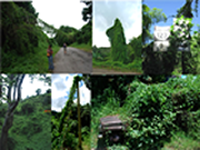
We are investigating the large-scale dynamics of vines across a complex
environmental gradient in the island of Puerto Rico. Using remotely
sensed data and ground thruthing we are mapping vine patches and characterizing
species composition and abudance. The combination of two sets of high-resolution
imagery collected 9 years apart will allow us to build vine patch networks
and begin to understand its large-scale dynamics.
Diana Delgado (Ph. D.), Josimar Figueroa (B. Sc.), and Diana Pabon actively partcipated
in this project
|
|
. |
Landscapes,
Water, and the Sustainable Management of Tropical Watersheds
Water
is not only one of our basic needs, but also a resource that
is critical for the sustainable development of our society. This research is aimed at developing a framework that incorporates ideas of sustainability and resilience for watershed management. Specifically we want to understand how interactions between spatially explicit
natural and social networks may contribute to the resilience,
and ultimately the sustainability of tropical watersheds.
We are using the Rio Grande de Arecibo watershed of Puert Rico watershed
as a model system for the island, and more broadly speaking for other tropical
regions. This watershed became a key player for the provision of potable
water in the island when a complex system of pipes was built to transfer
water across the island to serve the Metropolitan area of San Juan.
|
|
xx
ccc
This was an interdisciplinary collaboration with faculty
at UPR-RP and was initially funded through an institutional award
|
Phenotypic
consequences of habitat loss on tropical organisms
We
are interested in the mechanisms underlying phenotypic change in
fragmented habitats, including the
extent to which organisms are reslient to change.
We focus on body size, a universal currency
not
only reflecting a fascinating dimension of diversity but also
one related to a variety of physiological, morphological, behavioral,
life-history,
and ecological attributes of organisms.
We have been interested in: 1) characterizing the multimodal
distribution of body sizes, 2) understanding the functional
role of organisms sharing
similar sizes, and 3) examining linkages
between developmental processes operating at the level
of individuals
with ecological
process
operating at the
level of communities to understand the emergence of multimodal
distributions in body size. In particular, we have explored
the degree to which habitat
loss may have altered developmental stability, and whether certain
body sizes are more likely to exhibit higher levels of fluctuating
asymmetry or morphological variation that may make them less
likely to persist in altered environments.
These
questions have been addressed at a variety of scales and using
different approaches including field and laboratory work, the
compilation
of large databases, photographing or x-raying preserved specimens,
and
using GIS. We have focused on birds, amphibians, and butterflies
to accommodate students' interests.
Students
Zuania Colon (M.Sc.), Patricia Torres and Ivana Resto (B.Sc.)
are currently working on the project "Subtle skeletal abnormalities
in two species of frogs (Eleutherodactylus) with
direct development increase with forest fragmentation."
|
|
Body
Size
there
may be more than one solution for one give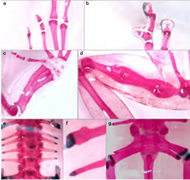 n ecological n ecological
problem, we need not expect
all individuals within a population
to overcome such
problems in he
.
|
|
|